WeblogPoMoAMA Day 2!
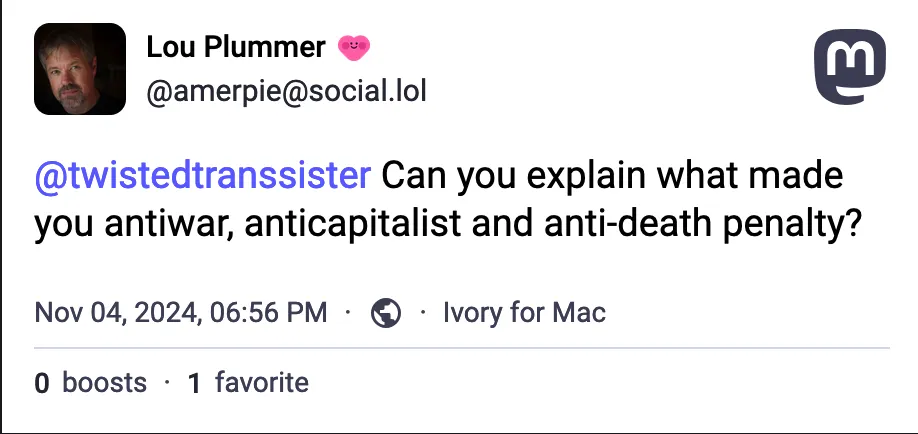
Starting strong with these core beliefs! These three values have been central in my life for 35 years. Let’s begin with the anti-war stance.
I was in seventh grade on September 11th, 2001. That morning, in my small-town middle school in New Pekin, Indiana, was like any other. I was in trouble—likely for talking too much in class, which was a frequent issue back then (and hasn’t improved much over time). I was on my way to the principal’s office, as usual.
When I reached the office, the entire staff was gathered around a TV, watching the events unfold. They told me not to say anything to anyone when I got back to class, to avoid causing panic. It’s not as though New Pekin would be a target, barely a blip on the map even to Southern Indiana. At first, I felt the sadness and strange surge of patriotism that swept over the country. But when we went to war in Afghanistan and Iraq, I couldn’t make sense of it. Neither of those countries attacked us on 9/11, yet we were sending young people to the other side of the world to kill people who had not harmed us.
My stepdad was a Vietnam vet. He told me stories of the horror he witnessed, the atrocities committed against innocent Vietnamese civilians, and the ways our own military mistreated its troops. It wasn’t something I’d wish on anyone. As the years dragged on, the parallels between Vietnam and these wars became harder to ignore—the deception, the unnecessary civilian deaths. It seemed senseless, much like Vietnam, with the public being fed lies just to justify the war.
This leads me to my stance against the death penalty. As a Jew, I believe life is sacred—a belief shared by many faiths. Taking a life is one of the gravest wrongs one can commit. Growing up, I was taught a simple but powerful concept: “Two wrongs don’t make a right.” So, if someone commits murder, should they be murdered in turn? I don’t believe so. If murder is wrong, then it’s wrong to murder a murderer. That doesn’t mean there shouldn’t be consequences, but the state shouldn’t have the right to kill.
This was more theoretical for many years. Then, this past February, I was put to the test. My cousin, my childhood best friend, was murdered by his girlfriend. My heart is filled with anger toward her, something I’m working on, but I still don’t believe she should be sentenced to death. Why should her family suffer the same grief we are feeling? She has a young child; why pass this trauma to them? Not to mention, our justice system is far from perfect. People are wrongly convicted all the time, only to be exonerated years later. Sometimes even that isn’t enough to secure their freedom because our society has become so desensitized to violence—but that’s a topic for another day.
Finally, my thoughts on anti-capitalism. In theory, capitalism could be beneficial, but in practice, it often leads to corruption. I grew up in a poor family. My grandmother worked her entire life, yet in her old age, she has little to show for it. This isn’t an exception; it’s common. In school, we were taught that socialism, communism, or anything besides capitalism was “evil” and that capitalism was the only viable system. But as I grew older and looked around, I couldn’t ignore the harm capitalism causes. Are other systems flawed? Absolutely. But we don’t live under those systems—we live under capitalism.
Capitalism plays a role in many of our current crises: economic, environmental, political. It’s tied to the military-industrial complex, the prison-industrial complex, even our healthcare system. When profit incentivizes imprisonment, killing, and cutting corners, people will pursue those avenues. I believe in the sanctity of life—Palestinian lives, the lives of my conservative neighbors, my own life, and even the life of the woman who killed my cousin.
At the core of my beliefs is Tikkun Olam—the Jewish concept of “repairing the world.” We can’t repair the world by bombing it into oblivion, by stripping it of resources for future generations, or by retaliating against those who do wrong. As Dr. Martin Luther King Jr. said, “Darkness cannot drive out darkness; only light can do that. Hate cannot drive out hate; only love can do that.”