Not Another Election Post sigh
As Cyndi Lauper once joked to Cher at the Kennedy Center Honors: “I lied.” Election Day is fast approaching, and early voting has already begun in many places, including here in Texas. While I’d planned to vote early this week, I’ve been under the weather, so I’ll head to the polls next week.
Lately, the election has been on my mind a lot. As a political enthusiast, I’ve been consuming social media and watching videos from various sources. It’s left me feeling a mix of emotions—everything from hope to frustration.
A quick rundown of my political journey: I started out as an anarchist. I hated authority and believed that as long as people weren’t hurting each other, they should be free to live as they pleased. This rebellious attitude got me into trouble often as a kid. In fact, I practically had my own seat in the principal’s office!
In high school, I moved to an Air Force town where politics was a constant presence. I became more aware of political issues and identified as a Democrat since nothing the Republican Party stood for aligned with my views. I was fiercely anti-Iraq War and an outspoken critic of President Bush. Around the 2008 election, I discovered Ron Paul and the Libertarian movement—his “Revolution” slogan (with the "evol" spelling out "love") resonated with me. I even found out that Penn Jillette, of Penn and Teller, was a Libertarian, and it felt like I’d found my people.
I joined the Libertarian Party but soon found myself feeling out of place as the Tea Party gained influence. Left-leaning Libertarians like myself were sidelined, leaving me politically homeless. That’s when I started exploring socialism and alternative political philosophies. I realized that my beliefs aligned more closely with socialist ideas. I also learned that Libertarian Socialism wasn’t the contradiction some people made it out to be.
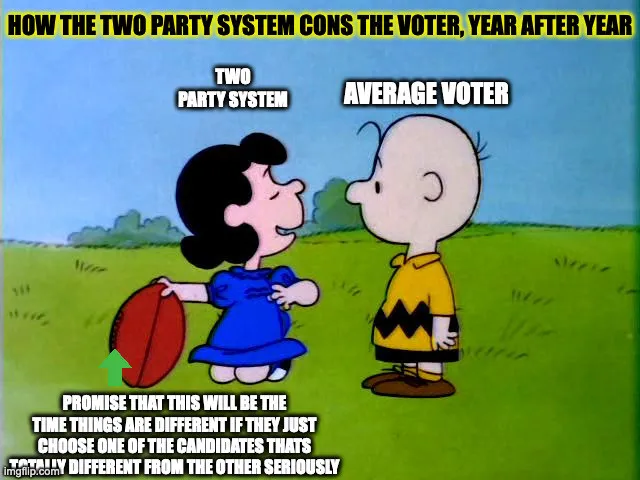
These days, I’ve been reflecting on how broken and toxic American politics have become. We have two major parties that claim to be vastly different, yet they often end up serving similar interests. When you cut through the spin and propaganda, they’re more alike than many people realize.
For most of the country’s 248-year history, the United States has been at war—around 230 to 240 years, depending on the definition. That fact doesn’t change regardless of which party is in power. We are a deeply militaristic nation, and a lot of our politics revolve around preserving a capitalist system where big business wields enormous influence through lobbying and media control.
Both parties also use identity politics to keep people divided and fearful. There’s a lot to be concerned about, both internationally and domestically. Around the world, nationalism is on the rise, and authoritarian leaders are gaining power. Here in the U.S., a blend of extremist Christian ideology and far-right politics is growing stronger.
This dangerous alliance targets marginalized communities—trans people, drag performers, people of color (through voter suppression and systemic racism), and anyone who challenges the status quo. We’ve seen this play out in attacks on pro-Palestinian protesters, the rollback of reproductive rights with the overturning of Roe v. Wade, and more.
With all this in mind, it’s easy to feel like our votes don’t matter. But that couldn’t be further from the truth. A Donald Trump presidency would be disastrous for the country. While I’m not enthusiastic about voting for the Democrats, I have to acknowledge that even with her flaws, Kamala Harris is a much better choice than Trump. That’s why I’ll be casting my vote for her, and I encourage others to do the same. We can’t afford to have a leader who aligns with fascist ideals.
But voting for Kamala isn’t the end of the story. After Election Day, it’s crucial to start exploring third parties and supporting candidates at the local and state levels who align with your values. Real change starts locally—state and local offices are where a lot of governing actually happens.
If we can make third parties viable at those levels, we can start challenging the dominance of the two-party system nationally. Ending this political duopoly should be our long-term goal